In which a renewable-energy zealot from San Francisco reaches out to talk to rural community members opposed to a solar energy project. The conversation goes well … at first.
Background
Most of my career I’ve worked in tech, and in semi-retirement I switched to being a startup investor. Some of my investments are in renewable energy, mostly because I am worried about climate change.
Although I believe in wind and solar energy, I’m uncomfortably aware that it’s not scaling fast enough to meet the climate challenge. To get to net zero emissions we will need maybe 30x the renewable energy we have now, and there are lots of barriers to getting there (see my extremely long post Friction in the Energy Transition). Not the least of these is the “Not In My Back Yard” (NIMBY) reaction of people who really do not want to live near wind and solar plants.
While searching for something else, I stumbled on an open Facebook group called “Stop [County] Solar”, where residents of a rural county in a western state were banding together to oppose a proposed solar farm in their area. I decided that it might be worth posting to the group, and hearing what they had to say.
My overture
Tim: “I would like to get a better understanding of what people who are opposed to this solar project believe, while being respectful of all points of view.
If I may ask: which of the following best describes your feelings and beliefs?
A) Climate change is not happening, or if it’s happening it’s not being caused by people
B) Climate change is happening and it’s caused by people, but it’s not a big problem
C) Climate change is a big problem, but we should address it without replacing fossil fuel use with wind and/or solar energy
D) We should build wind and solar farms to replace fossil fuel energy, but those wind and solar developments should be built in other locations, not this location
E) None of the above, or any beliefs or important points that don’t fall into the above buckets. (I hope that everyone feels free to speak their mind). Thank you.”
I thought that being polite might improve my chances of a real conversation. The submission dialog said that my post was awaiting moderation. I wasn’t optimistic, but the next day it was approved.
Dramatis personae
First names have been anonymized in alphabetical order of their appearance.
Alice – the group moderator
Bob – a local firefighter
Carol – local resident
Doreen – retired geologist, landowner
Eve – landowner with a solar deal
Frances – local resident
First responses
(Quotes edited for length)
Alice: “Tim, thank you…this is how I would like this group to work… there needs to be discussion about not just what is happening oin [local area], but all across [the State]. I do think we need to look at alternate sources of energy and a few years back I would have been all for solar. [..] I am not against solar at all, but I think in this great nation of ours there has to be minds that can come up with ways to implement it without destroying our farm and grazing lands and open spaces and creating an environmental disaster for the future. [Extended discussion of ugliness of solar, environmental impacts, reasons to hate it.] Rural [State] (and America for that matter) is being disproportionately tasked with shouldering the burden of taking care of urban America’s power needs. [..] At this point I feel that out of State companies (or companies based in other countries) like [Developer] are pretty much raping [State] for profit. I feel that the process put in place for approval of these solar projects is to assist in expediting the proponents of the projects when it should be first looking to the protection of our beautiful State and its residents.”
I reply sympathetically, and echo some of her points. For one thing, she clearly hates big solar developments with a passion and doesn’t want to live near one, and you can’t tell people that they don’t hate what they hate. She’s persuasive about a host of negative impacts. Finally she’s right about the burden of renewables falling disproportionately on rural areas. That’s partly about rural vs. urban land costs, but it doesn’t mean that it’s not unfair.
Bob: “My sentiments are similar to Alice’s, and I think she’s right on a lot of points. As a firefighter, Ill tell you that fires associated with solar farms are insanely toxic and that’s a fire none of us want to deal with. Aside from that, we’re concerned about the locking up of our land by big out of state corporations who don’t give a rats ass about the environment or our communities. [..] I agree we need cleaner solutions for growing energy demands but I don’t think its in solar at all. Plus no ones discussing the environmental impacts of mining all the minerals needed to build the panels and lithium battery banks. Sure, these energy companies SAY they’ll remove the panels and return the land to original condition if they stop being profitable but we all know that’s a lie. Removal is going to cost a fortune with no benefit for them, and what happens if they go bankrupt.”
I reply to Bob, replaying some of it back to him (and thanking him for the firefighting perspective). My only pushback is that with regard to needing cleaner solutions for energy demands, the only ones I know of, unfortunately, are wind and solar. (Well, nuclear also, but I don’t go there.)
Emerging themes: solar is ugly and environmentally destructive and dangerous, and the politicians and the out-of-state bigcorps who are pushing it can’t be trusted. Now, I didn’t really think that people would let me confine them to my A, B, C, D, E. buckets, but I would put Alice and Bob’s responses as a mix of C and D. They agree that we need clean energy, but say that there has to be a better solution than putting solar (specifically) in [County] (specifically). They don’t feel they have to have a solution in mind to be sure that this isn’t it.
The only person who was willing to just choose one of my buckets was Carol:
Carol: “D. We need them. But let’s use building roof tops. Parking garage tops etc. We also very much need farm land.”
I appreciated this: responsive and clear. My only disagreement (which I didn’t get into) is that I don’t think the arithmetic adds up – there aren’t enough rooftops and parking garages to be the whole solution.
Suspicion of the outsider
Doreen had clearly done some homework on me.
Doreen: “First off Tim you live in San Francisco and you are not a farmer. They are trying to cover 1000 of acres with solar panels, and these panels are not made in USA and they are made with slave labor from China.
[Omitted: a long well-researched list of the environmental and wildlife impacts that result from solar, as well as other negatives that (to me) ranged from the compelling to the seemingly crazy (e.g. that solar panels hum in a way that induces seizures in childen).]
And I understand you are a investor, so how much money are you getting???? This company [Developer] is getting their money from India.”
I tried to reply to her accusations, and also find some points of connection.
Tim: “Thanks for the reply Doreen. Right – I do not live in the area, and I am not a farmer. That’s why I am asking people who do live in the project’s area and who might be impacted by the project what they think. We do have some things in common though – we’re Americans, we share an atmosphere, and we share the climate. I am pretty worried about what’s happening already with extreme weather events which are likely made more extreme by climate change. I also have relatives who can no longer get insurance for their house in [distant rural area] because of increased fire risk. I don’t have any financial interest in this project and won’t get any money from it.”
Doreen did two things in reply: planted her flag firmly in bucket A (climate change doesn’t exist), but also became less suspicious and talked to me like a human being.
Doreen: “I am a geologist and the so called climate change is a hoax. The north and south poles have moved over 2000 times since the earth has formed and right now we are in a transition from El Nino to LaNina and each of these weather patterns have extreme weather. Each pattern takes somewhere between 20 -30 years to change and this is dynamic earth. [More geological and meteorological explanation …] By the way I lived in San Francisco in the 60s worked for [famous person] at [Organization] on [Street corner]. I lived in the Sunset district [..] and finally ended up in Oakland. Then moved to Napa [..] then moved to Oregon. Yes I love California, my brother lives in [Mxxx] and my daughter lives in [Rxxx]”
My reply:
Tim: “Wow, you’ve been all over the CA area. I live right near the SF Sunset district now. My wife has cousins near [various place-name callouts omitted]. I have to admit that you and I are not on the same page on the “hoax” thing, but thanks for the explanations from your geological expertise about the weather patterns and the movement of the poles etc.”
Although we tangled once more on substantive issues in a different branch of the thread, this branch turned into a friendly back-and-forth between me and Doreen, swapping stories and backgrounds.
Tension between the locals – and an ally?
Eve joined the conversation and was coming in hot – but her target was Alice, not me. And they seemed to have some prior history.
Eve: “Alice, again, much of your rhetoric is incorrect. Misinformation abounds, as do personal agendas. Let me be perfectly clear, I do have a solar contract. We’ve had every startup, snake oil salesman, con man group come through. That being said, we’ve had excellent companies offer contracts. We chose the company that best fit our plan. Most of these companies are here because we have low value ag land. Making a living on it is pretty damn tough. This where they should be building solar arrays. You live in Portland and have no knowledge of land, agriculture, and the economy. These companies put money back into the communities. [Long list of solar development benefits and reasons to believe solar is safe and non-toxic.]
It comes down to personal property rights. Don’t dictate to landowners what they can and can’t do. It’s not your land or livelihood.”
The conversation then went back and forth between Eve, Alice, and Doreen, including both accusations and denials about who lived in Portland and who didn’t.
So there are both pro-solar and anti-solar folks here in the community and the FB group. Maybe not everyone disagrees with me.
Ally? Not so much
Then Eve came for me, in response to my fire risk comment.
Eve: “Tim, you may want to check with Newsom and the California legislature on: 1- why insurance companies have pulled out of California 2- how the above (Newsom & legislature) and environmentalists stopped forest management with thinning and undergrowth removal 3- how they let the brush take over in LA, rather than use good management practices. It’s time for a reality check…”
I wasn’t sure at this point if she saw the fires as part of a larger trend.
Tim: “What kind of reality check? Do you believe that climate change is not playing a role in increased severe fires?”
Eve: “Climate change and good management practices are 2 separate issues. Good forestry practices, with thinning and removing undergrowth reduce the chance of large fires. California has had torrential rain in the past 2 years. Laws have been passed that prohibit forest management in Northern California There’s been a surge of brush growth in LA county. Nothings been done to remove it. That’s a fire waiting to happen, and guess what it did. You can go on about climate change, but the fact is that these fires were man made by ignoring the problem. The fault lies directly with Newsom, California’s legislature, and environmentalists who have no clue about “nature”. Their stupidity, ignorance, and stubbornness have cost the people of California billions of dollars.”
At this point, Eve and I are recapitulating a well-known Left/Right divergence in explaining the LA fires. There’s the climate change lens, which sees a disturbing rise in extreme weather events globally, including fires, hurricanes, tornados, flooding. Then there’s the anti-California lens, that sees the fires resulting from local incompetence by the left-wing governor, in part due to his continuing with traditional left-wing environmental policies. We won’t converge. Nevertheless I persisted!
Tim: “I agree that those are two different things, and also that fires can have multiple causes and contributing factors. If you want to blame Newsom for the fires in California, go ahead. But also blaming Newsom for the fire seasons in Canada and Brazil and Australia would be a harder sell.”
Eve: “Tim, did I say I didn’t believe in climate change?”
Nope, she didn’t. She said “You can go on about climate change, but [the real cause of the fires is something different]”, which is subtly different from lack of belief in climate change, or even its causal contributions. And with regard to multiple causes: do I actually know anything about forest management for fire prevention? No, I don’t.
Things go south
As you may remember, I started out the thread doing my best to be polite and respectful, and trying to listen more than I talked. As you may also have seen, that was slipping – I was regressing back to my natural personality, and giving a little more pushback, and injecting my own opinions, and (just maybe) heading a ways down the road that has lecturing and mansplaining at the end of it.
But I’d been helped by the fact that these people had strong opinions, many of them well-grounded, and they knew their community, and had interesting life experiences, and had areas of expertise that I lacked (e.g. firefighting, geology) that were directly relevant to what we were talking about. Overall they were smart and not easy to dismiss. Then I met Frances.
Frances: What is the problem with what we have? Electricity is cleaner, low maintenance and has worked for a long time.
Here we go! I have met someone on the Internet who really doesn’t get something important, and I am just the right guy to explain it to her.
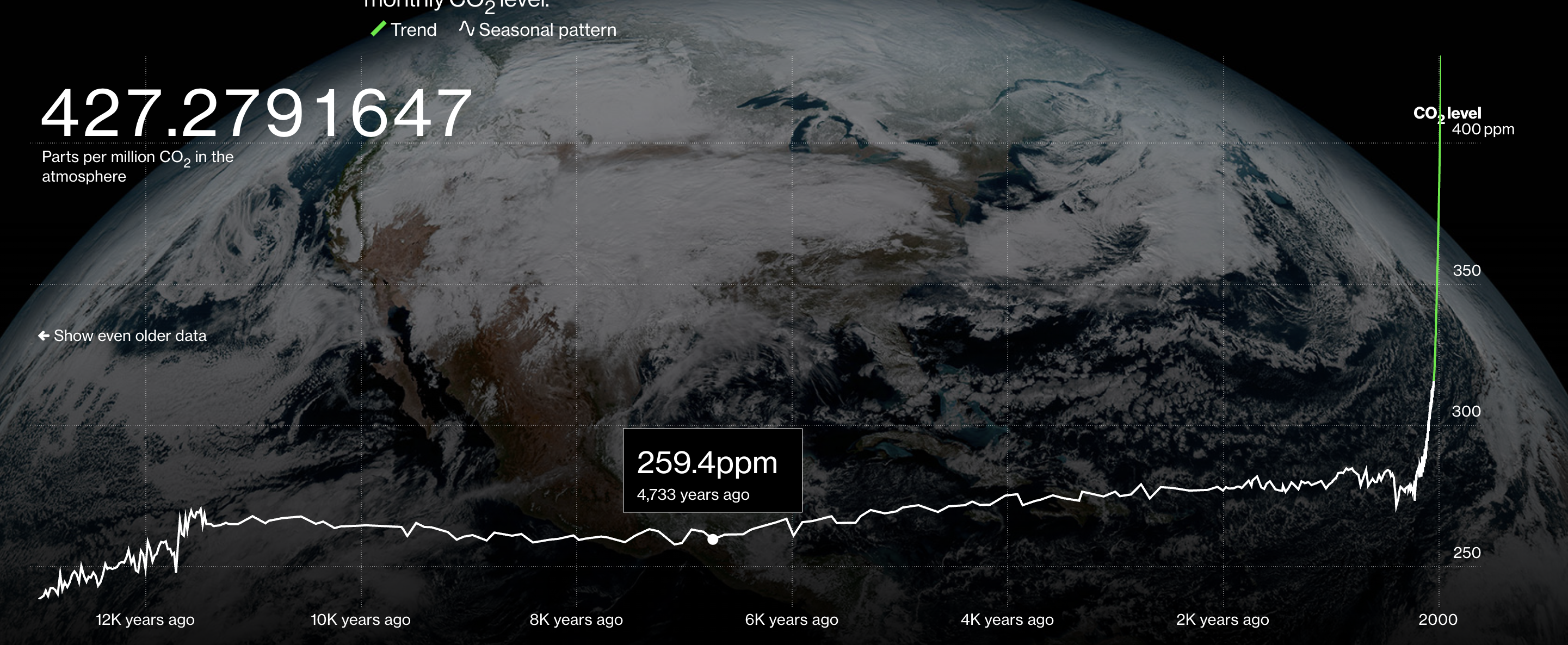
Tim: Here’s the problem with what we have. CO2 in the atmosphere over the last 12,000 years:
Frances: “We haven’t had electricity for 12,000 years.”
To her credit, Frances’s statement is correct. Yet there are concepts here that she is still unclear on, that someone should really explain to her. Who should do that explaining? Well, I’m right here….
I can do this. A simple words-of-one-syllable paragraph to fill in what she’s missing.
Tim: “Right. A lot of stuff has happened relatively recently (a century or two) because we got electricity, and dug up a lot of coal and oil to keep making more electricity. Burning coal and oil puts the CO2 in the atmosphere. If we keep burning it the amount in the atmosphere keeps growing. CO2 acts like a blanket trapping more of the heat from sunshine, so temperatures go up. We need electricity, but we need to make it without putting more CO2 in the atmosphere. Wind and solar make electricity without pumping out CO2.”
In her reply, she sounds more like some of the other people I’ve talked to in this group.
Frances: “I don’t feel that the solar panels are the way to go either. There are countries that use different more reliable and efficient power. We need to look into it. Not wind power though either.”
Frances agrees that we need power that’s clean, reliable, and efficient, and is not solar, and is not wind. She knows that we don’t have it here, so maybe that means they have it over there.
I know I have only two good choices: stop now, or (even better) have stopped earlier than now. I choose the third choice.
Tim: There are basically no non-CO2-burning energy sources to choose from other than: solar, wind, nuclear. So, we’ve got four choices:
1) solar 2) wind 3) nuclear 4) temperatures keep going up and up
She’s right that I didn’t include trees, so my list was not exhaustive (even though the point of the linked article is that planting trees is not the solution).
Doreen piles on with the last word of the night:
Doreen: Tim Converse that’s just a few people saying this not a proven fact and co2 is needed for plants and trees to survive. You listen to , too much News Media do some real research. Heck Ivermectin helped cure the so called covid and Ivermectin and Pancur are curing cancer.
The party’s over
The next day I stop by my favorite new Facebook group to see how the conversation has developed, and instead of that conversation I find this:
Hmmm. Either the public group has been turned into a private invite-only group, or I specifically have been blocked from it. I send the link to a friend, and he can get in just fine. So it’s me, specifically.
And … you know, that’s fair. I am not part of their community or their cause. I arrived and started to talk with them, and they decided to let me in because they had a pro-free-discussion ideology and gave me the benefit of the doubt, and because I was on my best behavior and promised to be polite. As the conversation progressed I evidently became less polite and more challenging and more lecturing, until they came to the probably-correct conclusion that letting me in had been a bad decision in the first place, and decided to reverse that, which is totally their prerogative. So it’s my fault, at least mostly.
But … it’s also partly intrinsic to the situation and the topic. The topic is a bummer, and the message I was coming in with is a bummer. The message is that there is a big problem, and there are a finite number of ways we can respond to the problem. And (I promise you) when you look at all of the possible ways to respond, you won’t like any of them! So you will say “I don’t want any of those! There must be something else!”. But quite likely there isn’t anything else. So the only thing left to do is to block the channel where that message is coming in.
Sad little coda
A couple of days ago I, um, devised a way to read the group’s content despite being blocked. I definitely wasn’t going to try to post anything, but I was curious how the group stood. The top message was:
Alice: I will be shutting this group down in the next couple of days. I am not certain if a new FB group will be established but if it is I will not be a part of it. I had started this group because I was quite frankly angry that the property I was in the process of purchasing was not going to be what I intended it to be.[..] I was willing to fight for my dream. [..] Over the last week I have come to realize that fighting for my dream would come at the expense of not only the dreams of others, but also the needs of others. [..] We are all doing the best we can to survive in a rapidly changing world and make the best decisions for ourselves and our families. What I have always believed and what I have once again remembered is that we need to be kind and tolerant of each other. I wish everyone well in the decisions they make for their futures.
I am pretty sure that this was not a reaction to my contributions or my incursion. The thread I launched was only one of 90 threads in the group, and definitely hadn’t been active in the past week. A lot of the other more recent threads were more extreme and more angry, and the anger seemed to be between locals. It was clear that the community itself was divided between solar opponents (like Alice and Doreen) and solar champions or beneficiaries (like Eve), and that some of the champions saw their dreams and their needs depending on the project going ahead. It seems that that was not a fight that Alice wanted to fight anymore. Much respect for that hard decision.

 tim-converse.com
Leave a comment